Every entry below is written from the slab: what the pigment is, where it comes from, how it behaves in water and in oil, how much binder it drinks, and what it does next to its neighbours. The wall is the index; click a block to jump to its entry.
Earths are pigments dug from the ground and washed; minerals are stones crushed and graded; the short list of synthetics at the foot of the page is made in a works rather than found. The colour-index name ties a pigment to its chemistry whatever the seller calls it, which is why we print it larger than the trade name. Lightfastness is listed on the jar exactly as the maker publishes it and never graded by us.
Yellow ochre
PY43 · earth
A clay coloured by hydrated iron oxide, dug from open beds and washed rather than manufactured. The tone varies by bed from lemon-leaning to nearly orange, which is why the jar carries the origin as well as the name.
In water it lays a warm, faintly granulating wash that lifts cleanly. In oil it is semi-opaque with a soft body, dries at an ordinary pace and takes a moderate drink of oil for a paste that stays workable.
Next to ultramarine it makes the quiet greens of a Norfolk field; with a touch of red ochre it warms into a flesh tone. It tames any green that has gone too sharp.
Raw sienna
PBr7 · earth
An iron earth with more clay and less oxide than ochre, which is what makes it transparent. Golden in the jar, gold-brown on the slab.
In water it is one of the best glazing earths, a clear honey wash that shows the paper through it. In oil it is thirsty, taking noticeably more binder than ochre for the same heap, and the paste can feel stringy until it is fully mulled.
Over a white ground it glows; over a dark one it goes muddy, so keep it for glazes and upper layers. It sits well beside terre verte.
Burnt sienna
PBr7 · earth
Raw sienna heated until the iron oxide loses its water and the colour turns to a fiery red-brown. Still transparent, still an earth.
In water it granulates gently and stains a little more than raw. In oil it is a reliable glazing colour of moderate oil appetite, drying evenly.
With ultramarine it makes the classic pair for greys, from warm to cool, without any black. Beside phthalo green it reads as a clean brick red.
Raw umber
PBr7 · earth
An iron earth carrying manganese, which is what gives it the cool, greenish cast and its habit of drying fast.
In water it granulates markedly and settles into the paper's grain. In oil it drinks a great deal of binder for its weight and dries quickly, which makes it a favourite for underpainting where the next layer must not wait.
It greys a warm colour without dirtying it. Next to yellow ochre it reads almost green; next to burnt umber it is plainly cooler.
Burnt umber
PBr7 · earth
Raw umber calcined to a warm chocolate brown. Denser than the raw form and a little less greedy for oil.
In water it lays a rich, even wash with less granulation than raw umber. In oil it dries fast and hard, one of the quickest of the earths, so keep it out of thick final layers that need to stay open.
With ultramarine it gives a deep, warm black that reads more naturally than any black pigment. With chalk it makes the beige of an old wall.
Red ochre
PR102 · earth
An earth coloured by anhydrous iron oxide. Sold under many trade names; the colour-index name is what tells you they are one family.
In water it is opaque and strong, so a little goes far. In oil it takes very little binder, mulls quickly into a dense paste, and covers in one layer.
Its tinting strength surprises beginners: a trace pinks a whole batch of white. Beside terre verte it sings; beside burnt sienna it looks flatter and cooler.
Terre verte
PG23 · earth
A green earth from the minerals celadonite and glauconite. Weak, quiet and irreplaceable for the cool underlayer beneath a warm skin tone.
In water it is transparent and low in body, better as a glaze than a wash. In oil it is very thirsty and the paste stays thin and buttery however much you mull it; expect a soft, slightly translucent film.
It cannot overpower anything, which is its virtue. Under red ochre it produces a convincing shadow flesh; next to malachite it shows how little green it really carries.
Chalk
PW18 · mineral
Ground calcium carbonate. Not a strong white in oil, and not meant to be: it is the body of a gesso and the extender that gives a lean paint its tooth.
In water, and especially in size, it dries to a soft, chalky white with good coverage. In oil it goes almost translucent, which is why it is used in grounds and glazes rather than as a covering white.
Mixed with any earth in size it makes the pale distemper colours of an old kitchen. It softens a black without turning it grey.
Lapis ultramarine
PB29 · mineral
Ground and washed lapis lazuli. The same colour-index number as the synthetic, and nothing like it on the slab: coarser, greyer, and it granulates like a beach.
In water it settles into every hollow of the paper and gives a broken, luminous blue. In oil it takes a large drink of binder and keeps a slightly gritty hand; it is a glazing pigment, never a covering one.
Beside synthetic ultramarine it looks almost violet-grey; beside azurite it looks warm. Yellow ochre and lapis make a slow, dignified green.
Azurite
PB30 · mineral
A copper carbonate mineral, crushed and washed into grades. The coarse grade is the blue one; grind it fine and the colour pales towards a sky grey.
In water and in size it keeps its depth and shows a crystalline sparkle. In egg it is at its best. In oil it drinks a great deal of binder and its colour is known to shift towards green as the film ages.
Next to lapis it reads greener and harder. It is best kept away from strong oil mixtures and given a lean binder of its own.
Malachite
PG39 · mineral
Azurite's green sibling, the same copper carbonate family in another crystal habit. Sold as a coarse grind for the same reason: fine, it turns pale.
In size and egg it gives a clear, sparkling green with visible grain. In oil it is thirsty and the paste stays sandy; use it in thin glazes over a smooth ground rather than as a body colour.
It sits naturally with red ochre and yellow ochre. Beside phthalo green it looks like what it is, a stone rather than a dye.
Bone black
PBk9 · mineral
Charred bone, ground. A soft, slightly brown black with a fine texture, listed here with the minerals because it is a calcium phosphate char rather than a soot.
In water it gives a warm grey wash that granulates a little. In oil it takes a fair amount of binder and dries slowly; it is the one to reach for in a mixture, and the one to avoid as a thick final layer.
With yellow ochre it makes a convincing olive. With chalk in size it is the grey of old plaster.
The few synthetics we keep
Four made pigments, chosen because no earth can do what they do: a clean blue, a clean green, a rose that does not brown, and a black with real covering power. They are listed on the wall as synthetic so nobody mistakes them for a mineral.
Ultramarine
PB29 · synthetic
Made, not mined: the same compound as lapis, fired from clay, soda and sulphur, and ground fine and even. It is the blue most painters mean when they say ultramarine.
In water it granulates a little in the coarse grade and hardly at all in the fine. In oil it is transparent, takes a fair drink of binder, and can look stringy on the slab until fully mulled.
With burnt sienna it makes the whole family of greys and near-blacks. Beside lapis it is cleaner and colder.
Phthalo green
PG7 · synthetic
A copper phthalocyanine, deep and blue-leaning, with tinting strength that has to be handled with a knife tip rather than a spoon.
In water it stains the paper and will not lift. In oil it is transparent, takes little binder for the colour it delivers, and one small jar outlasts a large jar of any earth.
A trace turns yellow ochre into a leaf green; more than a trace takes over. Mix it with red ochre to bring it down to something a landscape can bear.
Quinacridone rose
PV19 · synthetic
A modern organic pigment: transparent, clean and cool. It fills the gap no earth can, the rose that does not go brown.
In water it is a staining, transparent wash that mixes clean violets with ultramarine. In oil it is a glazing colour of moderate binder appetite; the tube never quite covers.
Beside red ochre it shows exactly how much yellow an earth red carries. With a little chalk it makes a cool pink for underlayers.
Mars black
PBk11 · synthetic
A synthetic iron oxide, dense and opaque, the black to reach for when a bone black is too soft.
In water it lays a flat, even, cool grey to black. In oil it takes little binder, mulls quickly, dries fast and covers in one pass.
It cools everything it touches. Warm it with burnt umber before using it in a shadow.
Choosing between two earths
Two jars of yellow ochre from different beds can sit a whole step apart in warmth. The only reliable way to choose is to see them brushed out side by side in your own binder, which is what a swatch card is for.
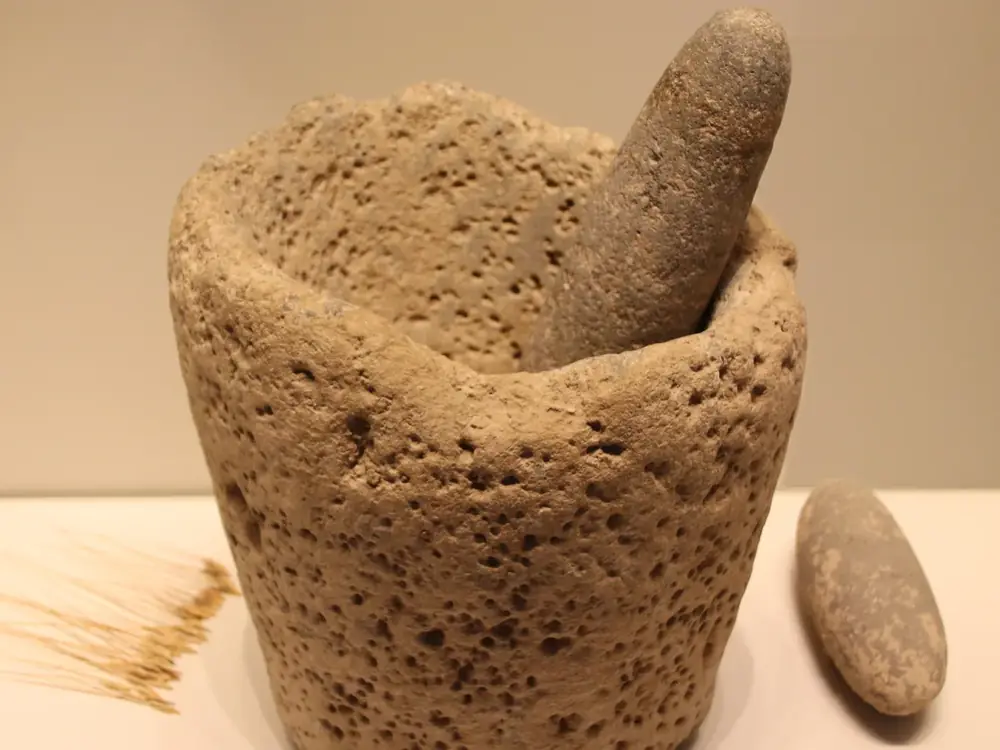
A deep stone mortar with its pestle. Azurite and malachite are broken and graded in something like this long before they reach a slab, and the grade is what decides the colour.